Blog Archives

Jury Trial Waiver In Montgomery County Circuit court and Impeachment through use of Conviction of Resisting Arrest.

Banks v. State

The Court of Special Appeals of Maryland held that, should a defendant decide to waive his Sixth Amendment right to a trial by jury, the trial court must announce this decision on the record in open court, acknowledging the defendant’s knowing and voluntary waiver of this constitutional right.  If this procedural requirement, as set out in the Maryland Rules, is not followed, any resulting convictions will be vacated.  See Md. Rule 4-246(b).  In this case, Appellant was found guilty by a Montgomery County Circuit Court judge and convicted of child sexual abuse and two counts of fourth degree sexual offense.  Appellant’s assertion that the trial court did not substantially comply with Maryland Rule 4-246(b) was upheld.  A variance from the procedural requirement, which results in the announcement not being made on the record and in open court, will not meet the strict requirements of this Rule.[1]

The Court also held that the crime of resisting arrest[2] cannot be used to impeach a witness’s credibility, upholding the Montgomery County Circuit Court’s decision to sustain the objection in response to Appellant’s attempt to impeach the State’s witness using this conviction.  In Maryland, impeachment by evidence of criminal convictions must either fall under the category of an “infamous crime” or be relevant to the finder of fact on the issue of a witness’s credibility. See Md. Rule 5-609(a).  When analyzing the crime of resisting arrest (or other crimes that do not fall under the purview of the latter category) the Maryland Court held that the elements should identify behavior that would tend to show the witness is “unworthy of belief.” See State v. Westpoint, 404 Md. 455, 484 (2008).  Based on this analysis, the Court determined that the elements of resisting arrest do not require proof of conduct regarding an accused’s trustworthiness and, therefore, may not be used in a subsequent proceeding to impeach a witness’s credibility. 

This ruling acts as a safeguard of sorts, preventing the proponent of irrelevant potential impeachment evidence from injecting doubt on aspects of a witness’s character that have nothing to do with his or her honesty. Furthermore, the Court’s prohibition of impeachment by means of a conviction for resisting arrest will prevent confusion of the issues by the jury.


[1] See Valonis and Tyler v. State, 431 Md. 551, 563 (analyzing Rule 4-246(b) the Court wrote, “In other words, the judge is required to announce his or her finding as to the knowing and voluntary waiver on the record”).

[2] See Md. Code, Criminal Law § 9-408 (2012). 


The Work Product Doctrine and Other Crimes Evidence.

Thomas v. State.

The Court of Special Appeals of Maryland held that the disclosure of a recorded statement that contains only the verbatim statements of the witness (facts) is not protected under the work product doctrine.  In this case, appellant asserted that statements taken and recorded from two State’s witnesses by the defense’s investigator were not subject to disclosure by defense, and that the trial court erroneously ordered defendant’s disclosure under Maryland Rule 4-263(e)(6).  Appellant argued that because the statements were not used during trial and were protected by the work product doctrine, they were not discoverable.

However, after a closer analysis of the Rule and defense’s disclosure obligations therefrom, and after reviewing the record and finding that defense counsel would use these statements during trial if one of the witnesses changed their statement, the Maryland Court disagreed.[1] Additionally, the Court found that because the recordings did not reveal the opinions, theories, or “creative thought process or mental impressions of counsel, but rather, they conveyed only the verbatim factual content of the witnesses’ statements” the trial court’s order compelling discovery under Maryland Rule 4-263(e)(6) was warranted.

The Maryland Court also affirmed the lower court’s ruling allowing evidence of appellant’s other crimes after a finding of the following: the evidence fell under one of the exceptions listed in Maryland Rule 5-404(b) or special relevance; clear and convincing evidence of the other crime; and that its probative value outweighed the danger of its prejudicial effect.  In this case, appellant was convicted of first degree murder and the State attempted to show, through evidence of a prior drug deal with the victim in the case.  Appellant asserted that because the drug charges originated from 2007, evidence from this case was too attenuated and would unfairly prejudice him. However, the Court notes that this drug case was postponed on September 10, 2009 and the victim “was murdered three days later, on September 13, 2009.”  Here, the Maryland Court found that this evidence had special relevance towards establishing appellant’s motive.

Additionally, the State’s proffer that court records, testimony from the prosecutor in the drug case, and an audio and video recording of the transaction show his involvement by clear and convincing evidence was accepted by the Maryland Court of Special Appeals.  Regarding the balancing test, outlined in Maryland Rule 5-403, the Court gave great deference to a trial court judge’s discretion, and in this case found that because there was little explanation regarding the killing, this evidence was probative and outweighed its prejudicial effect.


[1] See Md. Rule 4-263(e)(6) (2013); see e.g., State v. Young, 767 P.2d 90, 93 (Or. Ct. App. 1989) (“if defense counsel, even though not certain, can reasonably predict that she will use certain exhibits to impeach a State’s witness, she must give timely discovery to the prosecutor”).


Montgomery County judge allowed to re-seat a stricken juror in criminal trial.

Khan v. State.

Juror 95

The Court of Special Appeals of Maryland held that the Montgomery County Circuit Court did not err in upholding a Batson challenge when the proponent of the peremptory strike did not provide an explanation that was not pretextual or prove, to the satisfaction of the court, that purposeful discrimination had not occurred.  In this case, an employee of a downtown Silver Spring cosmetics store was indicted by a Montgomery County grand jury on charges of committing a sexual offense and second-degree assault.  At the conclusion of his trial, he was convicted with one count of second-degree assault.  During jury selection, the court made note that appellant’s counsel used five of the allotted peremptory strikes against white men, prompting the court to issue a Batson challenge.[1]

In contesting the Circuit Court ’s Batson challenge, Appellant argued that his race-neutral explanations for striking juror 95 were improperly classified as pretextual.[2]  In support of this argument, Appellant cited to the trial judge’s acknowledgement that, counsel was being “candid” during his explanation, but, he “does not have to buy it” as proof that the trial court erroneously categorized the explanation as pretextual.  However, the Maryland Court of Special Appeals found this interpretation of the Batson analysis flawed.

 Instead, the Maryland Court reasoned that, simply because the trial court believed parts of defense counsel’s reasoning behind the strike, “does not mean that the court was required to exclude the challenged juror.”[3]  Rather, the court must also determine whether purposeful discrimination was at play when jurors were stricken (the third step of the Batson analysis).  Because the trial judge noted a pattern of strikes against white male jurors, defense counsel’s proffered explanation had not been previously accepted by the trial court, and his prior noted explanations for strikes were inapplicable to juror 95, this Court found that the Montgomery County trial judge did not err in his decision to reseat juror 95.


[1] See generally Batson v. Kentucky, 476 U.C. 79 (1985) (overruling the former rule which required challengers/opponents of peremptory strikes to prove a systemic pattern of discrimination.  Instead, the Batson Court delineated a three part-test to determine whether a peremptory strike is being used to discriminate on the basis of race or gender/in violation of the Equal Protection Clause of the Fourteenth Amendment.  First, a prima facie case of discrimination must be established/found.  Second, the proponent of

the strike must provide a neutral explanation for each strike.  Third, the trial court, considering all of the circumstances, must decide if purposeful discrimination has occurred.).

[2] Defense counsel noted that he struck “juror 95” based on his conservative appearance and the fact that he was a government attorney.

[3] Khan v. State, page 10.


Reasonable Fourth Amendment Searches: When do state actors need a search warrant?

Cory Jamaul Jones v. State of Maryland.

The Court of Special Appeals of  Maryland affirmed the judgments of the Wicomico County circuit court holding that a search warrant does not have to be obtained before the collection of gun shot residue (“GSR”) from a suspect’s person.  On November 5, 2010, Appellant, along with an accomplice, shot a female driver eleven times in a robbery gone terribly wrong.  The driver suffered serious wounds to her lower back and abdomen, pubic area, right thigh, and left leg.  With the help of GSR[1] evidence, Appellant was tried and convicted of attempted first-degree murder, first-degree assault, use of a firearm in the commission of felony, and illegal possession of a regulated firearm, in addition to related convictions.  As a result, he was sentenced to life imprisonment on the charge of first-degree murder and two consecutive terms of five years for the firearms convictions.  Appellant appealed his conviction on three grounds, two of which are discussed here.

Here, the Maryland Court of Special Appeals held that the use of GSR evidence in Appellant’s trial did not violate his Fourth, Fifth, or Sixth Amendment rights.  Before being formally charged, while Appellant waited in the booking area, detectives took a GSR sample from Appellant’s left hand.  Although Appellant protested[2] to the swabs, samples were sent to a forensics lab for further analysis.  On appeal, Appellant asserted that taking the GSR constituted an unreasonable search under the Fourth Amendment.  In support of this contention, he argued that taking the samples was invasive and did not fall under any exceptions to the warrant requirement in violation of his Fourth Amendment rights.  The Maryland Court of Special Appeals found otherwise, reasoning that the search was minimally invasive (analogous to the taking of fingerprints or cheek swabs for which there is no warrant requirement)[3] and justified by exigent circumstances, qualifying as an exception to the warrant requirement.

Although Appellant did not properly preserve his right to argue a violation of his Fifth and Sixth Amendment rights, the court nonetheless addressed why these arguments lacked merit.  Regarding Appellant’s Fifth Amendment rights, the Court cited to several other jurisdictions that found GSR tests to be nontestimonial in nature[4] in support of its contention that Appellant was not entitled to relief under the Fifth Amendment.[5] Last, because Appellant’s right to counsel had not yet attached, he was not afforded the right to the presence of counsel, provided for under the Sixth Amendment, during the taking of the samples.


[1] During the trial, testimony was taken explaining that “a GSR kit consists of multiple small swabs that are rubbed on a suspect’s hands and the webbing of the fingers to collect any chemical residue given off by a discharged firearm.  The swabs are then sealed back into the kit and submitted to the crime lab for analysis.”

[2] During the collection of the GSR sample, Appellant indicated that “he wanted to make no statements without a lawyer present.” Appellant also questioned whether detectives had a warrant to conduct the GSR test.

[3] See Maryland v. King, 133 S. Ct. 1958, 1980, 186 L. Ed. 2d 1, 2013 U.S. LEXIS 4165 (U.S. 2013) (reversing the decision of the Maryland Court of Appeals by holding that “[w]hen officers make an arrest supported by probable cause to hold for a serious offense and bring the suspect to the station to be detained in custody, taking and analyzing a cheek swab of the arrestee’s DNA is, like fingerprinting and photographing, a legitimate police booking procedure that is reasonable under the Fourth Amendment.”) available at http://www.supremecourt.gov/opinions/12pdf/12-207_d18e.pdf.

[4] Appellant also conceded that GSR tests are nontestimonial.

[5] “The protections of the Fifth Amendment prohibiting the admission of compelled statements or physical communications that are self-incriminatory do not apply to physical characteristics such as the giving of a blood sample, voice sample, or handwriting exemplar. Pennsylvania v. Muniz, 496 U.S. 582, 595-98 (1990); United States v. Dionisio, 410 U.S. 1, 7 (1973); Gilbert v. California, 388 U.S. 263, 266-67 (1967).


Montgomery County judge denial of criminal defendant’s mistrial motions affirmed.

Choate v. State

The Court of Special Appeals of Maryland recently affirmed a Montgomery County Circuit judge’s ruling denying Appellant’s motions for mistrial.  The Court held that the grant of a mistrial is not warranted when the defendant has not suffered irreversible prejudice[1] and when the prosecution’s statements in closing do not create an inference that the defendant should have taken the stand.[2]

This case arises from a trial in which Appellant was convicted of first degree rape and two counts of first degree sexual offense of a Bethesda woman.   As a result, he was sentenced to three consecutive life sentences.  In Appellant’s Brief submitted to the Court of Special Appeals of Maryland, he asserts that his two motions for a mistrial were erroneously denied.  His first motion, made during State’s closing, asserted that he was in fact prejudiced by the trial court’s ruling allowing the State’s reference to facts not introduced into evidence.  Specifically, Appellant cited to the victim’s testimony regarding a screw driver that was allegedly used by Appellant during commission of the crime.

During the State’s case-in-chief, the victim was shown a screw driver found in the van in which Appellant was stopped and arrested.  Her testimony indicated that she was unsure whether the screw driver shown to her was the same one used by the Appellant.[3]   As a result, the Court ruled that the screw driver would be “admitted as the screwdriver Agent Willis[4] had recovered from the van.”  Additionally, the Court prohibited the prosecution from arguing that the screwdriver introduced into evidence was the one used during the attack.  Notwithstanding this limiting instruction, however, the prosecution, during closing, argued that “she’s grabbed by the defendant, who holds this screwdriver . . .”.  Pursuant to the limiting instruction, the Court instructed the jury to disregard this statement.  However, on appeal, the Court found that these statements were permissible concluding that because a reasonable jury could draw an inference that the screw driver presented during trial was the screw driver Appellant used (and trial counsel was free to argue the opposite) the statement did not give rise to a mistrial based on the Maryland Court’s standard of review.
The second motion, made during the State’s rebuttal, concerned Appellant’s contention that the State created an improper inference to the jury regarding Appellant’s decision not to testify. It is well settled law in Maryland that a criminal defendant has the right to decline to testify and not be penalized for this decision.[5]  Appellant cited to a portion of the State’s rebuttal that “[t]here were only two people there” and that, the victim “came in and . . . sat here and  . . . told you what happened” as statements that created an unlawful inference that the defendant’s silence should be seen as guilt.  However, this excerpt of the rebuttal was a small portion of the five pages containing the State’s arguments bolstering the victim’s credibility because she was the only other witness to the crime other than the Appellant.  As such, the Court found that the Montgomery County judge did not abuse his discretion in denying trial counsel’s second mistrial motion.


[1] See Choate v. State, at 10 (quoting Behrel v. State, 151 Md. App. 64, 142, 823 A.2d 696, 741, cert. denied, 376 Md. 546, 831 A.2d 5 (2003) (“A mistrial is . . . an extreme sanction that sometimes must be resorted to when such overwhelming prejudice has occurred that no other remedy will suffice to cure the prejudice…the remarks must be a direct and contributing factor that resulted in egregious prejudice to the defendant.”)) available at http://www.mdcourts.gov/opinions/cos/2013/0922s12.pdf.

[2]See id., (the Court, when reviewing “the denial of a motion for mistrial for abuse of discretion . . . will reverse only where “the prejudice to the defendant was so substantial that he was deprived of a fair trial.” Cooley v. State, 385 Md. 165, 173, 867 A.2d 1065, 1069-70 (2005)” available at http://www.mdcourts.gov/opinions/cos/2013/0922s12.pdf.

[3] When shown the screwdriver found by law enforcement, the victim testified, that it “could be [the screwdriver used by the appellant], but I can’t swear that it was.”

[4] Agent Willis was the patrol officer who stopped Appellant, in a van, on a Virginia state highway several hours after the victim reported the crime.

[5] See Md. Dec. of R. art 22; see also Md. Courts and Judicial Proceedings Code Ann. § 9-107.


Maryland Pattern Jury Instructions.

Hall v. State.

In a close decision, the Court of Special Appeals of Maryland affirmed a ruling from the Circuit Court of Baltimore City permitting the reading of an Allen-type jury pattern instruction[1] that did not strictly adhere to the language included in the instruction.  Although the Court noted that, the Circuit Courts should avoid the sort of divergence that occurred in this case, ultimately, the instructions were upheld.  The Maryland Court ruled that the instructions given did not alter the substance of the Maryland Pattern Jury Instructions (“MPJI”), nor were they found to be unduly coercive.[2]

On appeal, Appellant cited to two instances that, in his view, were impermissibly coercive: 1) the Court’s altered instruction directing the jury “to decide” as opposed to “deliberate” (which is what is written in the instruction); and 2)the trial court’s preface to the instructions in which the judge announced that the jury reached an impasse due to one juror.  In response to Appellant’s arguments, the Maryland Court maintained that the instruction’s potential coerciveness, read in context, was lessened by language emphasizing the importance of each juror reaching an individual judgment that is accurately reflected in the final verdict.  Additionally, the Court found that this divergence did not materially alter the substance of the instruction.

The Court of Special Appeals used analogous reasoning with respect to Appellant’s second argument.  Here, the Circuit Court judge intimated that he did not wish to appear critical of the single juror and stressed that each juror conform with his/her belief when attempting to reach a verdict.  After reviewing the record, the Court stated that “the content of the instruction given remained within the spirit of the ABA-approved instruction . . .”.


[1] See generally Allen v. United States, 164 U.S. 492, 501-02 (1896) (“It certainly cannot be the law that each juror should not listen with deference to the arguments and with a distrust of his own judgment, if he finds a large majority of the jury taking a different view of the case from what he does himself”).  Today, an Allen-type jury instruction refers to the instruction given when the jury indicates they are unable to reach a unanimous decision.  Trial courts must take special care to avoid coercion of jurors who are in the minority.  The Maryland Pattern Jury Instructions (MPJI) have adopted the American Bar Association’s (“ABA”) instructions, which differ from the Allen charge, in that they do not place an emphasis on jurors who are not siding with a majority of their peers to reach a decision.  Rather, the MPJI emphasizes the importance of reaching a collective decision which accurately reflects an individual’s decision based on his/her own belief.

[2] Hall v. State, at 15 (2013) (“While the language used by the court here comes close to instructions that have been rejected as impermissibly coercive, we believe that the instruction given here is distinguishable form those cases.”) OR “Although we do not recommend or condone all of the language used by the trial court here, when viewing the instruction in its entirety, we do not believe that it deviates in substance from the pattern instruction, and reversal is therefore not required” page 10).


Ruling of Prince George’s County Circuit Court judge affirmed

Sinclair v. State.

The Court of Special Appeals of Maryland recently held that the limited, immediate search of an arrestee’s cell phone, pursuant to a lawful arrest, did not violate his Fourth Amendment right against unreasonable searches and seizures.  The Appellant was convicted in the Circuit Court for Prince George’s County of various charges stemming from a carjacking in Temple Hills, Maryland.  The record reveals that minutes after the Appellant’s lawful arrest, the on-duty officer conducted a limited search of the cell phone found on his person.[1]  During the Appellant’s Circuit Court trial, defense counsel moved, in limine, to suppress the evidence seized from his phone.[2] The Circuit Court for Prince George’s County denied this motion, concluding that the search was valid incident to a lawful arrest.

On appeal, the Maryland Court struck down the Appellant’s claims, citing to a decision from the United States Court of Appeals for the Fourth Circuit.[3]  The Court of Special Appeals of Maryland balanced the Fourth Amendment rights of suspects against the need of law enforcement to preserve evidence when faced with nuances presented by modern technology.[4]  Here, the Court concluded that, because the search was close in time to the arrest and the officer “merely opened the appellant’s cell phone” to find the evidence on the screensaver, the search was valid under the Fourth Amendment.    

The Maryland Court also held that the introduction of other crimes evidence is proper, when the probative value outweighs any unfair prejudice that may arise.  Here, the Court reasoned that because both parties stipulated (and the jury knew) that Appellant was previously found guilty of a disqualifying crime, the introduction of other crimes evidence[5] related to this stipulation was not overly prejudicial.  Furthermore, use of this evidence was properly admissible for purposes of impeachment because it was related to a contested issue in the case.


[1] The evidence seized from the phone consisted of pictures found on Appellant’s screensaver which were later confirmed to be images of the stolen car.

[2] Defense counsel asserted that his Fourth Amendment rights protecting him against an unreasonable search and seizure when the arresting officer did not first obtain a warrant to search his phone.

[3] See United States v. Murphy, 552 F.3d 405, 411 (4th Cir. 2009) (holding “The need for the preservation of evidence justifies the retrieval of call records and text messages from a cell phone or pager without a warrant during a search incident to arrest.”).

[4] The Court made note that, because evidence, such as text messages, pictures, and the like, can be erased so easily and quickly, the need to preserve such evidence justifies the search of cell phones pursuant to a lawful arrest.

[5] At issue was a recorded phone call Appellant made to his probation officer.  At the trial level, defense counsel argued that the phone call’s prejudicial effect outweighed its probative value.


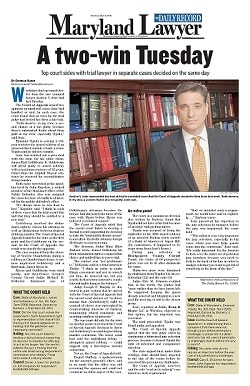
Rockville man savoring freedom after nine months in jail despite videotaped false confession

Man found not guilty following what lawyers say was false confession

by Danielle E. Gaines, Staff Writer

Washington dc defense lawyer

Christopher Anderson/The Gazette Marvin Cuque (right), who was released from jail and after serving nine months for a crime he was acquitted of by a jury, and his attorney, Andrew Jezic, talk about being able to spend the holidays at home with his family

Helen Vasquez told a white lie as her 4-year-old son peered through the plate glass at the Montgomery County Detention Center in March. On the other side of the partition was her husband, Marvin Cuque.

“Daddy’s dirty from fixing all the buses, so he has to stay back there,” she told their son. Cuque, a safety auditor at Washington Metropolitan Area Transit Authority, went along with the ruse.

Cuque’s wife visited her husband under the cover of that same lie for 40 minutes at a time, once per week, for the next nine months.

Cuque spent exactly 271 days behind bars last year — an ordeal he describes as “sort of like hell.”

He was released Nov. 30 — just in time for the holidays — after a jury concluded he was not guilty of the charges against him.

“It was a lot of pain. So much pain,” Cuque said later. “I had never been arrested before.”

The 35-year-old Guatemala native was arrested by Montgomery County Police on Sept. 17, 2010, and charged with second-degree sex offense, child molestation and abuse of a child by a custodian — crimes that could carry a prison sentence of more than 35 years. He was released from jail the same day, but later detained without bail, starting March 4, after prosecutors said his connection with Guatemala posed a flight risk.

According to police and prosecutors, the crimes Cuque was charged with occurred in 1999 or 2000 when he and a former girlfriend boarded with a woman and her three children at the White Oak Towers complex on Old Columbia Pike in White Oak.

During an interrogation with two police detectives in Rockville on Sept. 14, Cuque was flustered. He didn’t learn to speak English until he moved to Silver Spring in 1984 at the age of 6. In a psychological evaluation after his arrest, he said he still has difficulty “finding the right words in English.”

Toward the beginning of the one-hour-and-15-minute interrogation, when one detective asked Cuque if she was “right in thinking that, you know, you guys didn’t have full blown sex?” Cuque responded: “Not even touching.”

He went on to deny the allegations nine more times before answering “Yes,” when a detective asked if he felt bad about what had happened. When the detective asked him whether the girl had put her mouth on his penis, Cuque said “Probably, yeah, I guess so.”

Cuque explains the admission by a lifelong nervousness around police and a feeling that they were out to get him during the interrogation. During the psychological evaluation after his arrest, Cuque said he thought, “Even though I didn’t do it, if I admit to touching, it wouldn’t be a big deal and they will stop.”

Days later, he was arrested and charged. After meeting with an attorney and again asserting that he was innocent, Cuque entered an Alford plea, a plea in which a defendant refuses to accept guilt, but acknowledges the prosecution likely has enough evidence for a conviction.

Unlikely assistance

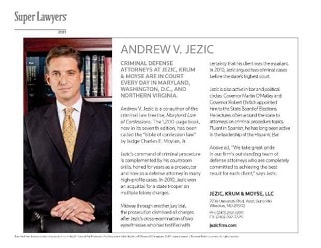
After a Montgomery County Circuit Court judge accepted the Alford plea in April and days before Cuque was scheduled to be sentenced for second-degree sex offense, the ex-girlfriend who lived with him stepped in. Her mother hired Wheaton-based attorneys Andrew V. Jezic and David H. Moyse to defend Cuque.

“It wasn’t a decision we jumped on,” Moyse explained later. “We had the video [of the interrogation], met with Marvin several times, met with experts. The bottom line was, we believed him when we looked at him eye to eye. False confessions do happen.”

The attorneys quickly came to think that several factors led to a false confession: Cuque’s stunted education, non-confrontational demeanor and tendency to please others — coupled with interrogation techniques that minimized the crime he was accused of and maximized the case against him with the threat that officers would “think the worst” if he didn’t confess.

Cuque said after police told him the girl had passed a lie detector test, he felt as though police would not believe he was innocent. He believed lie detector tests were 99 percent accurate because of their use on daytime talk shows, he said.

“In my opinion, given the totality of the circumstances, I feel that Mr. Cuque was at risk to make a false confession,” Dr. Michael J O’Connell, a forensic psychologist from Ellicott City, wrote in an evaluation of Cuque.

At trial, Jezic was barred from calling O’Connell as an expert witness on false confessions because Judge Robert A. Greenberg thought O’Connell would tell the jury information they could conclude through other testimony.

In the final hours of a five-day trial that stretched through the Thanksgiving holiday, Cuque’s attorneys presented the jury with a parade of witnesses who testified to his character. Among them was his boss at WMATA.

“To have 10, 12 people available as character witnesses, that is difficult,” Jezic said. “Because some character witnesses, when they know the charges, will back off.”

Helen Vasquez took the stand in defense of her husband as well.

“I was always supportive. I never doubted him,” Helen said. “I never doubted his honesty and his innocence. I knew I had to be brave and tell [the jury] who my husband was and that I knew the man I married.”

After six hours of deliberation, during which the jurors watched the interrogation video twice, they emerged with a verdict: Not guilty. On all counts.

“It was like a thunderbolt,” Jezic said.

After incarceration

Maryland jurors are anonymous in court and identified only by number. Although jurors could not be reached after the verdict, Jezic said he spoke with several of them.

“The jurors hung around and talked with us and it came down to not having much faith in the confession,” Jezic said.

The prosecutor, Deborah W. Feinstein, did not return a call for comment about the verdict. Montgomery County Police spokeswoman Sgt. Jennifer McNeal referred all questions about the crime to the State’s Attorney’s Office because she said it was an open case.

Cuque finds it hard to describe the emotions he felt as the verdict was read. The hours after were a blur as well.

“The first thing I saw was my wife and my son running toward me. It was very beautiful,” he said.

They walked together to California Tortilla, where Cuque ordered a soda and savored the moment.

“I couldn’t believe I was walking out of the court building and into freedom. The fresh air was the main thing,” Cuque said.

Cuque’s trials won’t soon be finished. His court file remains open to inspection, because it could hurt his bid for U.S. citizenship to have the records expunged. While Cuque has a green card, the ambiguous paper trail left by an expungement could create complications when he applies for citizenship, Jezic said.

Despite everything, Cuque said he has not lost faith in the legal system.

“In the end, the jurors did what our system allows,” he said.

While he was imprisoned, the life Cuque had worked so hard for came crashing down around his wife. Two of the family’s cars were repossessed, mortgage payments went unpaid. Helen went back to work at a former job with Chipotle, but couldn’t keep up with the financial demands.

For Christmas this year, the family had to wait until payday Dec. 23 to buy gifts and hurriedly wrap them on Christmas Eve, hours before the family’s celebration. Each year, at midnight on Christmas morning, before opening their gifts, the family gathers to pray and call extended family in Guatemala.

“Every time I talk to my mother, she cries,” Cuque said.

For Jezic’s part, he was pleased to be able to reunite a family for the holidays.

“Daddy was the biggest gift,” Jezic said.

dgaines@gazette.net


Prince George’s County Man, 19, freed after 7 months in jail; robbery testimony at odds

Man, 19, freed after 7 months in jail; robbery testimony at odds

By Ruben Castaneda

Washington Post Staff Writer
Saturday, January 9, 2010

For nearly four hours in June, Eric W. Johnson insisted to Prince George’s County police detectives that the two armed robbery victims who had identified him as a culprit were wrong, that he was innocent.

For seven months, Johnson, 19, remained in the county jail in Upper Marlboro, awaiting a jury’s decision on charges of armed robbery, first-degree assault, using a handgun in a crime of violence, 17 offenses in all, carrying the possibility of decades of prison time.

The jury never weighed in. On Thursday, before what would have been the second day of Johnson’s trial, Assistant State’s Attorney Ada Clark-Edwards dropped all charges against Johnson.

About seven hours later, he was released from the jail and celebrated by devouring a Big Mac meal at a McDonald’s restaurant.

“I think the criminal justice system works in wrong ways,” Johnson said in an interview less than two hours after he was freed. “I’m completely innocent.”

Clark-Edwards referred questions to Ramon Korionoff, a spokesman for State’s Attorney Glenn F. Ivey. Korionoff said the state dropped the charges because its two key witnesses were contradictory in their testimony and prosecutors no longer had confidence in their case.

For example, one of the victims, Lillian Hall, testified that the attacker she thought was Johnson had dark skin. Johnson is light-complexioned, defense attorneys Andrew Jezic and David Moyse said. The other victim, Timothy Flemmings, told police that the attacker he thought was Johnson hit him in the head with a gun; on the witness stand, Flemmings did not remember that, the attorneys said.

It is highly unusual for prosecutors to drop charges against a criminal defendant in the middle of a trial. In July 2006, Prince George’s prosecutors dropped double-murder charges against Edgar “L.A.” Reyes when cellphone records provided by a homicide detective during the trial cast doubt on the veracity of the state’s lone witness.

At the outset of the Johnson trial, Hall and Flemmings took the stand and testified that Johnson was one of several men who robbed them at gunpoint about 10:30 p.m. June 7 in the 5600 block of Auth Road in Suitland.

According to police charging documents, one victim, Flemmings, surrendered a cellphone and an iPod. Hall gave the robbers her purse, her wallet and $22 in cash. A third victim, a woman, gave up her purse and wallet.

Johnson’s hairstyle — he wears dreadlocks — is a reason he became a suspect, Jezic and Moyse said. The victims of that robbery said one of the attackers had dreadlocks and a cap.

About 5 1/2 hours after the Auth Road robbery, about 4 a.m. June 8, police were called to the scene of a robbery about five miles away, Jezic said. Johnson, who had been out at a nightclub, was spotted walking with two other men about six blocks from that robbery, Jezic said. The victim of the later robbery was brought to the street where Johnson and his friends were detained and said Johnson was not his attacker, Jezic said.

Nonetheless, detectives put Johnson’s picture in a photo array, and Hall and Flemings identified him as one of the men who had robbed them. The third victim said she could not identify anyone from the photo array.


Former Md. trooper found not guilty of 3 sex offense charges in Montgomery County

By Dan Morse

Washington Post Staff Writer
Tuesday, April 20, 2010

A Montgomery County jury Monday acquitted former Maryland State Trooper Marlon Iglesias of three sex offense charges related to a woman handcuffed after a DUI stop but found the trooper guilty of a charge of misconduct in office.

Charges against the trooper hinged primarily on the word of the alleged victim, who nearly a year after the traffic stop told authorities Iglesias has inappropriately touched and fondled her after she’d been pulled over on Interstate 270, handcuffed and taken to a nearby station. But during testimony, the alleged victim’s record for honesty was cast in doubt.

At the trial, the alleged victim testified that Iglesias handcuffed her and placed her in the front seat of his police car. She said that on the way to the station, he touched her thigh. She alleged that after she’d gotten to the station, he touched or fondled her at least two more times. And as he was letting her go from the station, she said, he also kissed her.

The jury deliberated for about four hours Friday. Jurors came back Monday morning and deliberated for nearly an hour.

The split verdict may have reflected jurors’ thinking that something untoward happened after the stop but not enough to deliver a more serious finding.

“We are very pleased that the jury acquitted him of all three felony charges,” said Iglesias’s attorney, Andrew Jezic, adding he will appeal the guilty charge.

“We are quite pleased with the jury’s verdict,” said Montgomery County Deputy State’s Attorney John Maloney. “The jury did not hear about a very similar incident that former trooper Iglesias had with another female, whom he had in his cruiser in January of 2009, shortly before he resigned in April 2009. That previous incident will be addressed along with his misconduct with the victim in this case at sentencing.”

Jezic said the incident was “investigated fully” by the state police, and charges were never brought.


FREE CONSULTATION

(202)413-5631

 LOCATIONS

DC Criminal Attorney